We build production AI systems for law firms and the agencies that serve them — AI Visibility, AI Intake, call intelligence, and AI-powered website production. Work with us directly, or alongside your existing agency.
Most AI engineers have one or two of these. Building production systems for agencies demands all three.
15+ years in enterprise software. Built and ran a digital agency. Leads the engineering and product strategy behind every NOOMA platform.
NOOMA started in a digital agency — SEO, SEM, web dev, full P&L through the dot-com cycle. We understand your business because we've been in your seat.
15+ years implementing enterprise software at Fortune 500 scale. The systems we build don't break at scale because we've operated at scale.
Intake platforms, visibility analytics, voice AI, multi-model orchestration — all in production, all for legal marketing. Velocity comes from operator instincts plus modern AI tooling.
Enterprise partner-training programs follow a fixed recipe: a team of instructional designers, an LMS vendor, video producers, and a project manager spend two-to-six months building the courseware. The output is good. The cost is in the six figures. For a fast-moving consultancy onboarding partners onto a new platform, that timeline kills the deal — partners need to be productive on the engagement before the curriculum even ships.
A complete partner-training portal generated end-to-end by one AI engineer. 11 lessons across 3 modules (data platform, journey orchestration, B2B). 17 interactive modules — some styled as "official vendor tutorials," some as custom strategy walkthroughs — each with slide navigation, narrated audio, and chapter markers. 47 hands-on sandbox tasks. 11 knowledge checks. A 20-question accreditation exam with auto-generated LinkedIn certificate. Everything orchestrated from a single hub with progress tracking, roadmap, and zero LMS dependency. The client and vendor in the demo are fictional. The engine that produces the curriculum is real.
No code editor. No team. No LMS. Retrieval-augmented generation turning natural language into production software — narrated lessons, interactive modules, an accreditation exam, the LinkedIn certificate. All of it.
Visit the live portal →Generative Engine Optimization is a real category most agencies can't speak to. Buyer-intent queries increasingly get answered inside ChatGPT, Perplexity, and Gemini — and when a reader does click through, GA4 files it under "Direct." Agencies are being asked to prove performance on a channel their tools can't see. There's no established playbook, and the existing tools each solve one piece and estimate the rest.
A SaaS platform combining three previously-separate capabilities: AI visibility scanning across six platforms in parallel — querying the same models real buyers actually see — evidence-based AI traffic attribution, and a Bayesian marketing mix model treating AI as its own channel.
The attribution engine doesn't guess. A visit is credited to AI only when a stored receipt proves an AI retrieval agent fetched that exact page minutes before the human arrived — bot fetch paired to human visit, attributed per platform. No heuristics, no inflated numbers. If Faneros says ChatGPT sent the visitor, it can show you the receipt.
Nine deploy-ready deliverables generate per scan. Fixed model routing assigns the right frontier model to each one, and every output passes deterministic structural validation plus an automated QA gate before it can be downloaded.
Adobe, Nielsen, and every legacy marketing mix model was built for a world where Google was the front door. When a visitor arrives from ChatGPT or Perplexity, the referral header is stripped — so traditional tools dump that traffic into "Direct" or "Unknown." The fastest-growing channel in marketing is invisible in every budget model on the market. No CFO can evaluate AI visibility as a line item, because no model puts it in the same view as everything else.
A self-serve Bayesian marketing mix model that runs entirely in the browser. Hill saturation curves fit per channel, MAP estimation across the time series, lagged cross-correlation matrix for halo effects, 200 iterations of marginal reallocation to find the efficient frontier. Upload three columns — channel, spend, conversions — and the model produces cost-per-lead rankings, response curves with 80% confidence bands, halo synergies between channels, and a specific reallocation plan in under ten seconds.
The differentiator: AI visibility sits in the model as a first-class channel alongside Google Ads, TV, SEO, and paid social — modeled with the same math. AI discovery stops being a vague strategic initiative and becomes a measurable budget line.

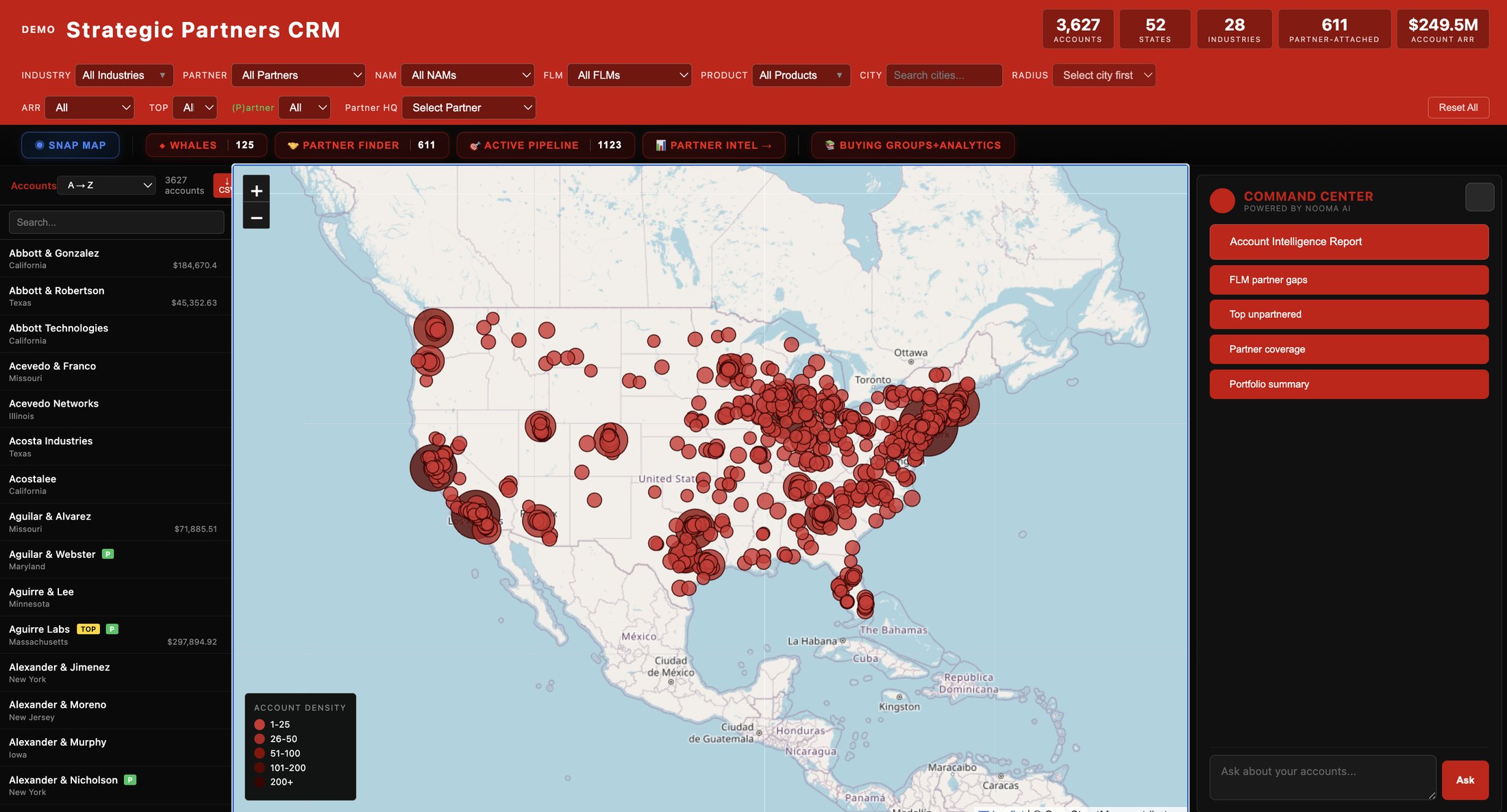
A North American field sales team of 38 account executives, each managing roughly 80 accounts in their patch. Every Monday, every seller faces the same question: which five accounts to call this week, which to deprioritize, and what to actually say when they get on the phone. Salesforce can produce a list and a CSV. It can't answer those questions. Sellers were guessing.
A single-operator platform that turns Monday-morning planning into minutes instead of hours. Three capability surfaces under one filter bar: territory hunting (drop a 15–50 mile radius around any city, see every account fully hydrated), one-click intelligence (executive briefings and internal sales plans generated in ~3 minutes from internal data plus live 10-K and 10-Q filings), and a manager-level coverage heat map for partner gaps and white-space planning.
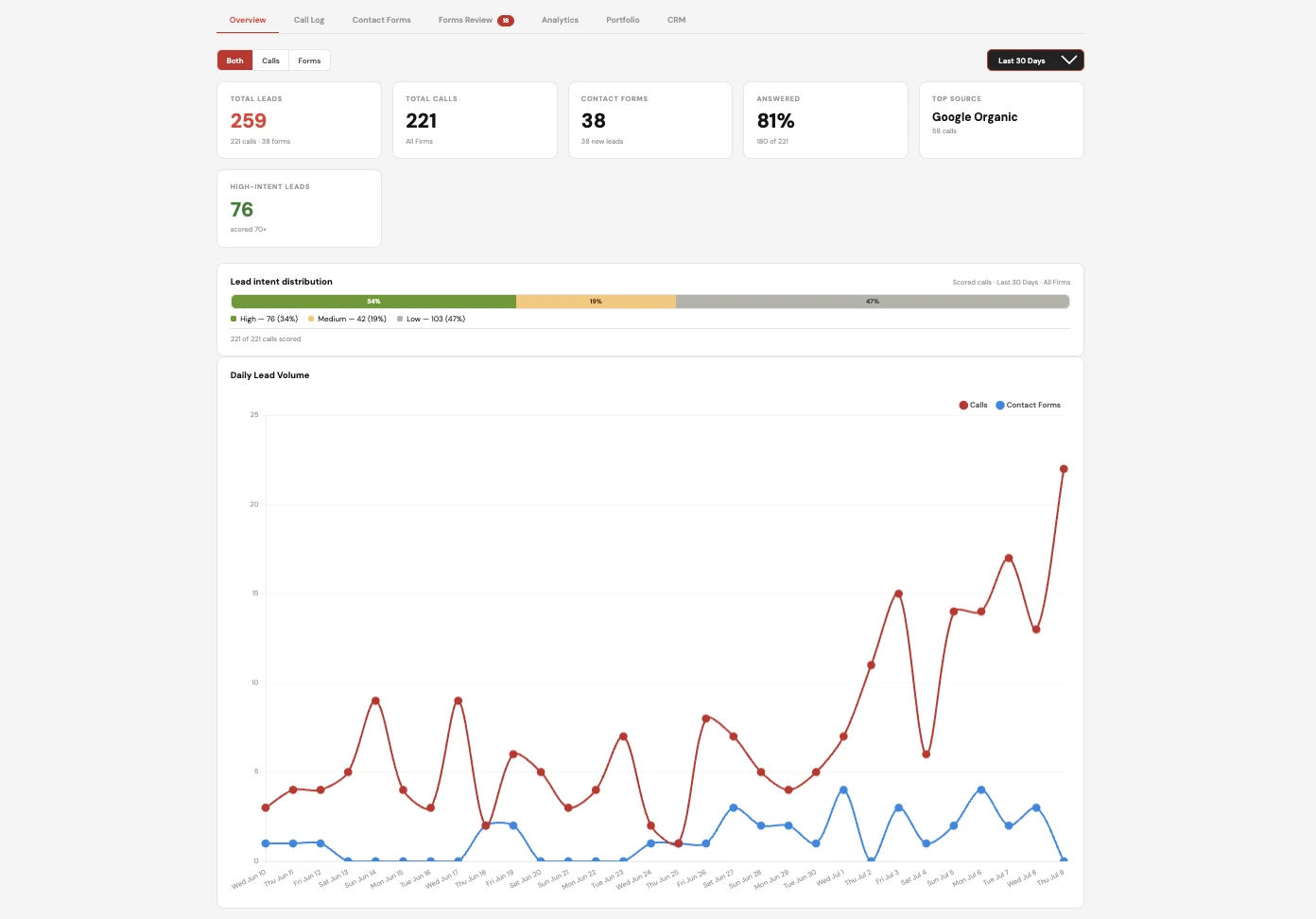
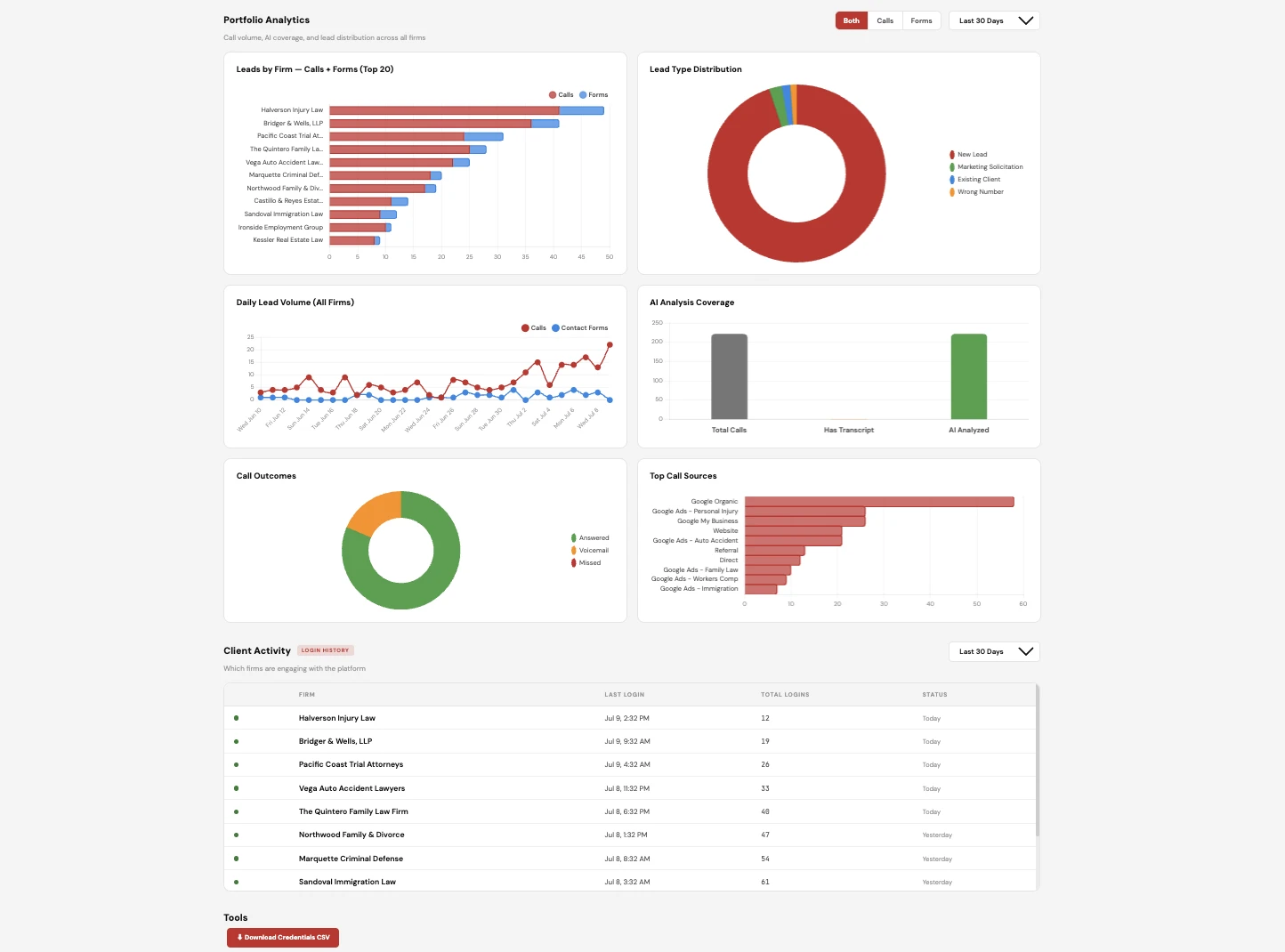
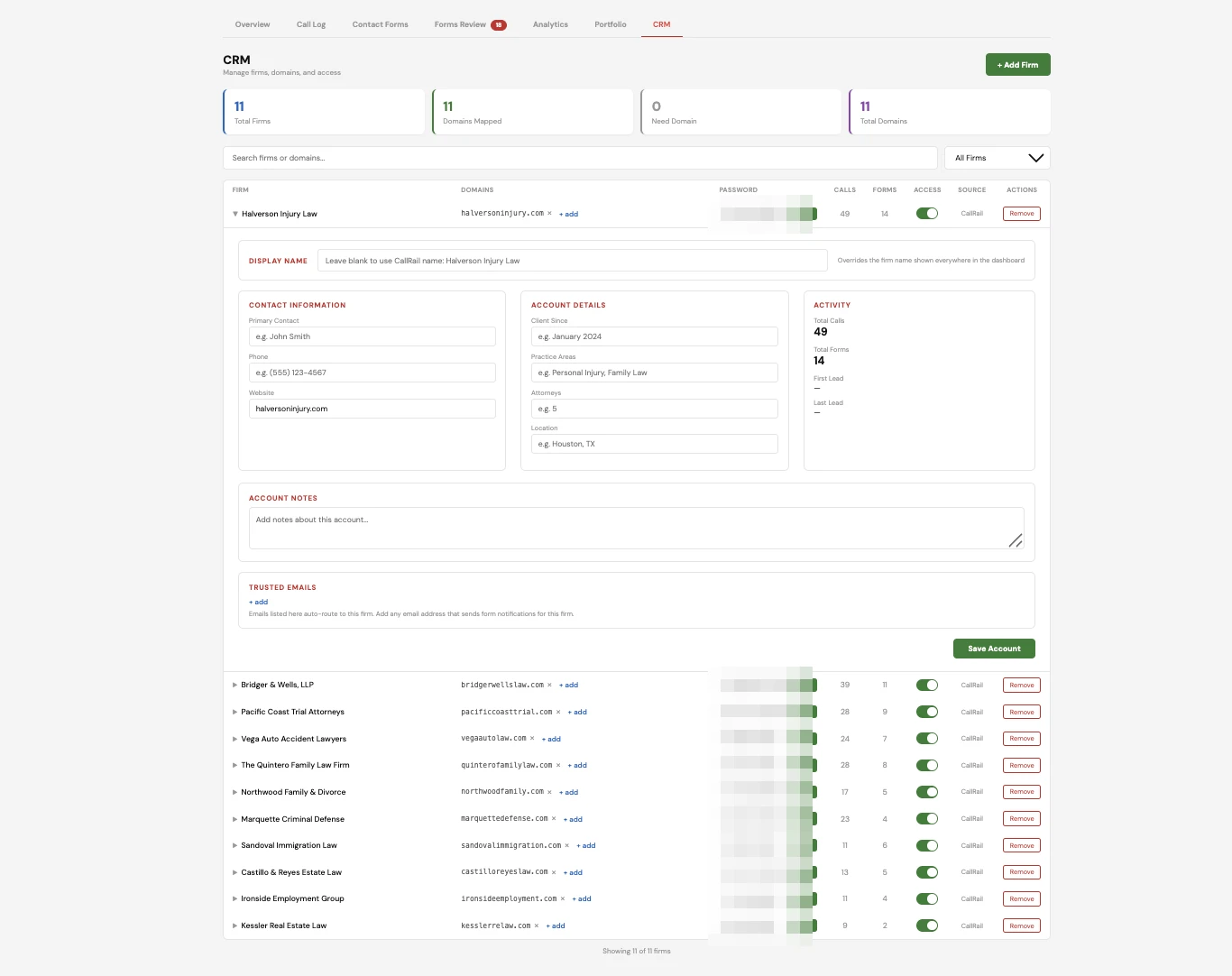
The agency manages intake for 230 personal-injury and consumer law firms. Calls come in across 13 CallRail accounts. Contact forms from 230 firm websites piped into a single inbox. Their operations team was manually triaging thousands of submissions a week. Real leads were slipping through.
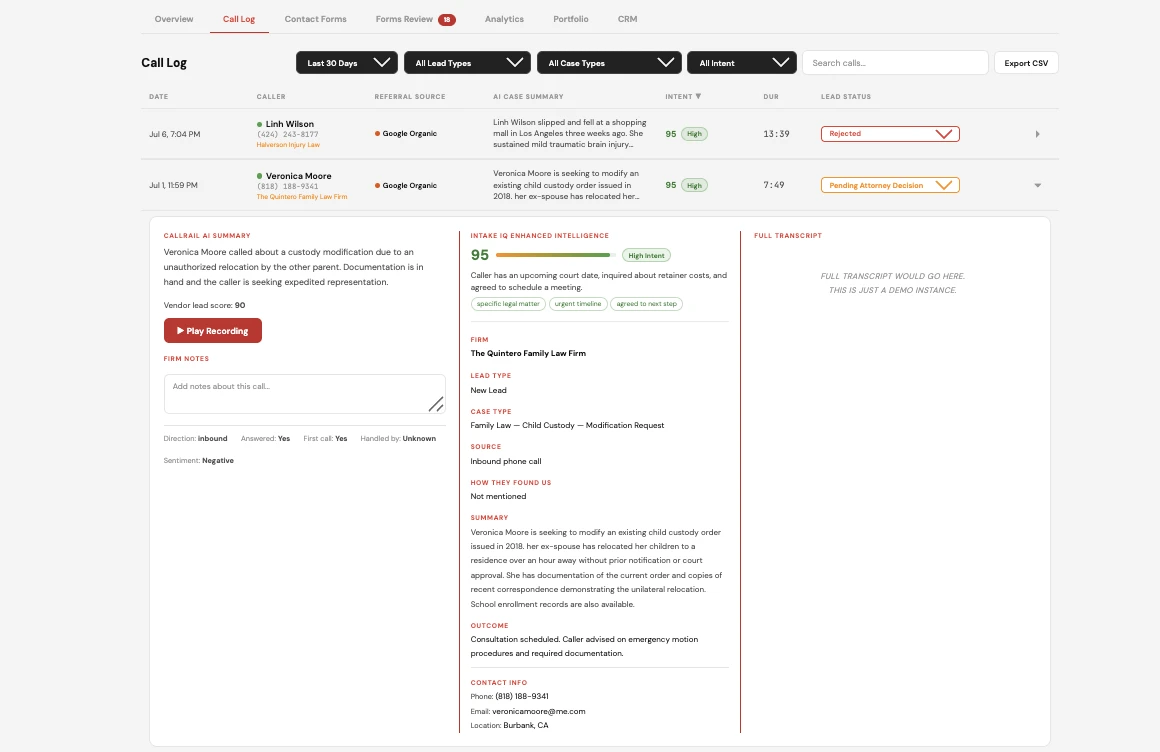
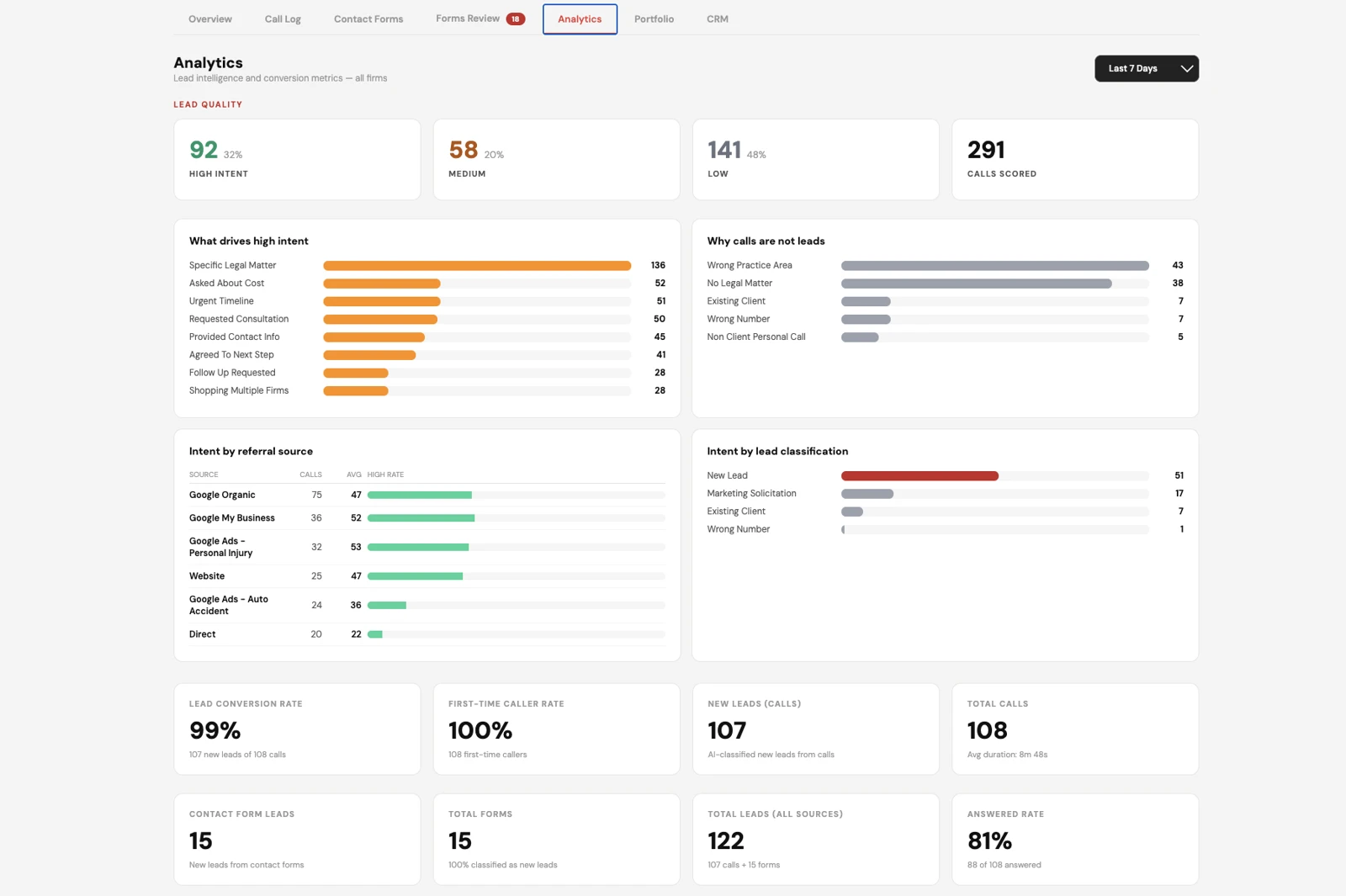
A unified data platform stitching calls and forms to canonical firm identities across multiple source systems. Real-time webhooks from 13 CallRail accounts feed an identity resolution graph that maps numeric IDs, website domains, vendor slugs, and sender emails to a single canonical identifier per firm. AI enriches every record with paralegal-voice summaries, lead classification, and urgency scoring.
A deterministic routing engine auto-approves submissions with zero manual triage. A multi-tenant denylist structurally prevents shared notification senders from misrouting leads across firms.


We don't chase AI trends. We build production systems that solve real operational problems. Every platform we develop begins as a business challenge inside a real company — not a demo created for a portfolio. That's why our work survives contact with production.
Some engagements start with the law firm. Some start with the agency. The best ones bring in both — like ours did.
The platforms your agency needs — AI intake, AI Visibility, automated WordPress builds — are already live and serving 230+ law firms. You're not paying for R&D.
One engineering partner replaces a team of developers, architects, and a project manager. No recruiting, no ramp-up, no management overhead.
CallRail, intake forms, WordPress, client reporting — we've built inside these systems, not around them.
NOOMA builds the technology. Your agency keeps the account, the billing, and the trust.
Average time from kickoff to a live, deployed system: ~3 weeks.
Multi-model QA runs against production 96×/day. Bugs are identified in 15 minutes and fixed in under an hour — before your clients ever see them.
Most teams gate production with one reviewer or one tool. When that vendor regresses — and they do — single-tool buyers absorb the full hit. BridgeBench measured Claude Code accuracy dropping from 83% to 68% over six weeks in early 2026 before Anthropic published a postmortem. Anyone who depended on it for review lost fifteen accuracy points without knowing it.
Four frontier-tier reviewer models run in parallel on every diff. Their outputs are synthesized into a single triaged review, calibrated against a benchmark I maintain — 35 production-shape bugs seeded into three Cloudflare Workers, weighted by severity, refreshed when any reviewer in the lineup is replaced.
Cost per pre-deploy check is roughly thirty cents. The ensemble catches what no single model catches — different reviewers have different blind spots, and stacking them closes most of the gap to the restricted frontier.
On May 15, 2026, this discipline took a 6,000-LOC production Cloudflare Worker — the system serving 230 law firms — through a full audit, refactor, and security-hardening cycle. Five deploy batches, six commits, review executed through Delphi — my proprietary multi-model code-review tool. Every major finding triaged and shipped.
Findings addressed included a multi-tenant block-sender failure class silently losing forms for a firm's own inbound leads, a full transactional rewrite of the firm-merge function that would have damaged the first merge under the old code, an atomic counter race in sender-trust recomputation, X-Forwarded-For spoofing in the auth rate limit, a KV check-then-set race, hidden-firm session revocation gaps, and a half-dozen defensive hardenings.
Pre-deploy review catches most bugs but not all. The rest reach production. And production drift can't be caught at deploy time at all — it happens later, against real data the deploy never saw. Most operational monitoring fires after a customer complains. The feedback loop from "something broke" to "we know it broke" is usually hours to days long.
An AI agent that runs every 15 minutes, asserts that the production system is doing what it's supposed to, and sends structured alerts to Nooma Engineering Managed Services on violations. It catches mechanism failures — the AI pipeline skipped calls it shouldn't, a sync watermark drifted, an invariant quietly broke after a migration — before they cascade into outcomes the client sees.
What separates this from typical monitoring is the loop. Detection without resolution is just noise. Every alert routes to Nooma Engineering Managed Services, who triages, fixes, and verifies — usually before the client knows anything happened. The system catches the bug; we close it.
This is the back end of a discipline that starts before deploy — every change goes through multi-model review in Delphi before it ships. Pre-deploy review, post-deploy assertions, managed resolution: a closed loop, end to end.
These are the actual products — running right now. Open a new tab, poke around.
AI Visibility platform — scans how six AI systems see your law firm and generates actionable fixes. Evidence-receipted AI traffic attribution.
faneros.ai →Three frontier AI models debate your question through multiple rounds. Sequential juror chain, TTS, consensus scoring. On the App Store.
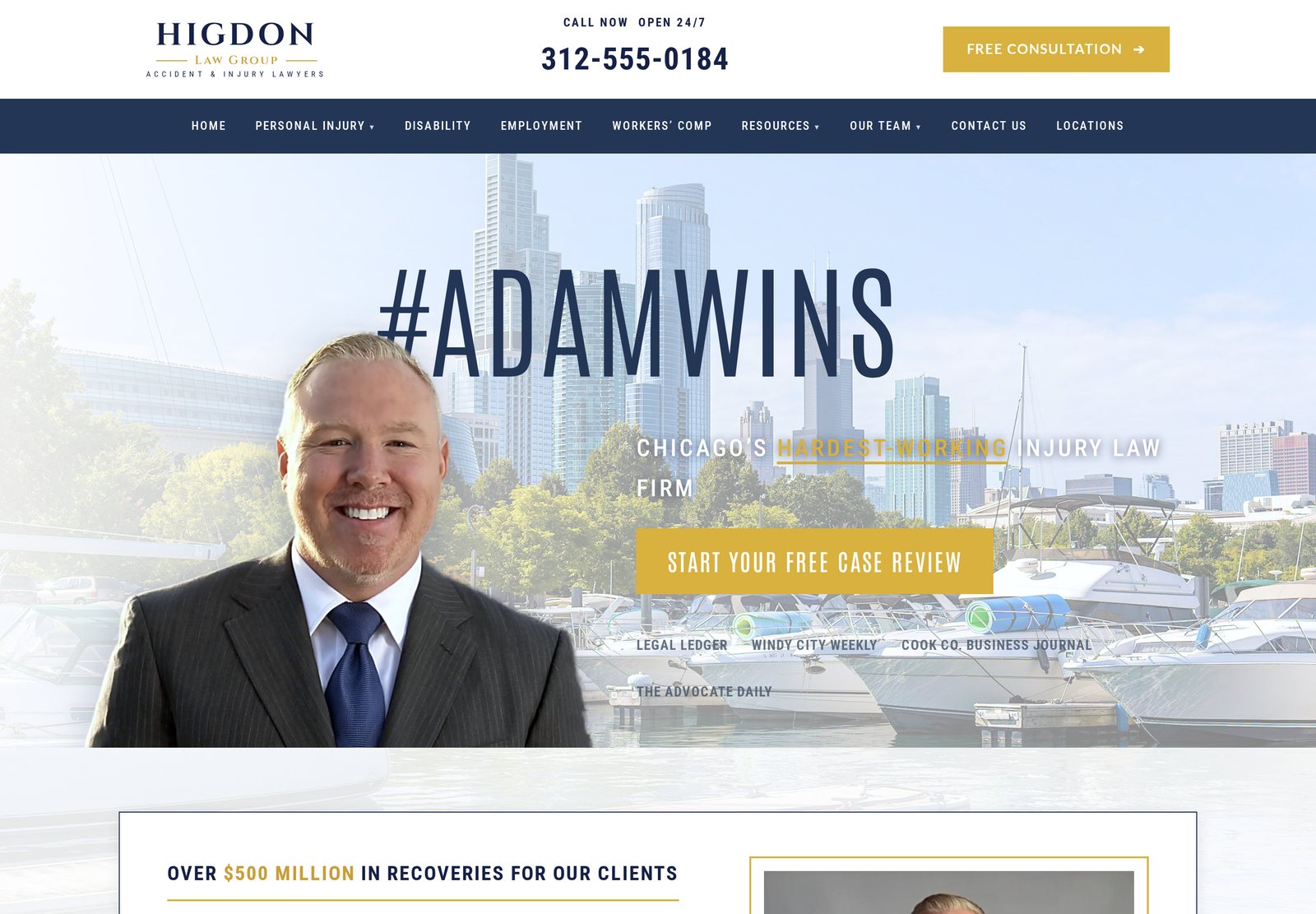
areopagus.ai →Full attorney website — extracted from a live reference, design-locked, and ported to WordPress in a day. Editable case results, practice areas, testimonials, and SEO. Clean code, zero page-builder bloat.
higdonlawgroup.wpenginepowered.com →Real-time voice AI receptionist. Healthcare and legal agents. Google Calendar booking, sub-500ms latency.
lunaphone.ai →Call intelligence dashboard. 50 firms, 1,742 calls analyzed, AI-categorized lead types, conversion analytics.
intakeiq-ai.netlify.app →Partner sales intelligence. 3,600+ accounts, interactive US map, AI Command Center, RAG over enterprise PDFs.
projectwarroom.netlify.app →Bayesian MMM with Hill curves, adstock, halo detection, efficient frontier. Runs entirely in-browser.
mix.faneros.ai →Build a custom AI chatbot through a no-code wizard. Knows your business via RAG, 50+ languages, deploy in minutes.
areopagus-ai-agent.netlify.app →AI-generated partner training portal. 11 lessons, 17 modules, narrated, with exam and certificate. Built solo in ~25 hours.
training-engine.netlify.app →Conversational AI in your Slack channels. Natural-language Q&A over live operational data, voice readouts in every reply.
slack-agent-demo.netlify.app →AI meeting participant. Joins your Google Meet, Zoom, or Teams call and contributes strategy and recommendations in real time — like a colleague, not a transcript.
Watch the demo →One engineering partner. Ten builds. All live.
Twenty minutes. You describe the problem. We tell you on the call whether we can ship in two weeks.
20 minutes · no cost · no slidesFree. Fixed scope. Working prototype in your team's hands by day ten.
Free · 2 weeks · no stringsHarden the prototype, deploy to production. Billing starts the day your team logs in.
1 week · bundled into retainerHosting, AI costs, monitoring, improvements. Full source access. Thirty-day exit.
Month-to-month · the code is yoursIf NOOMA can't build what you need in two weeks, you pay nothing.
Yes. Plenty of our work starts with a direct conversation with the firm. Often it grows to include your existing web or SEO agency — that's not a conflict, it's the best outcome. Our largest legal platform began exactly that way: a firm reached out, brought us to their agency, and together we built AI Visibility, call intelligence, and WordPress systems now serving 230+ firms. We extend your agency; we don't replace it.
We work with both. When we work through an agency, your agency owns the client relationship, the billing, and the strategy. We're the engineering team behind the scenes — building, deploying, and maintaining the AI systems that make your agency more valuable to its clients. Think of us as your embedded AI engineering partner.
Because most of that team exists to coordinate the team. A traditional shop needs a PM to translate, an architect to design, and developers who each see one slice of the problem. NOOMA does all four roles under one roof — no handoffs, no telephone game, no status meetings about status meetings. One partner owns the outcome.
You own everything. Every line of code lives in your repo, on your infrastructure, under your accounts. Every project ships with a handoff runbook a competent AI engineer can pick up in a day. The risk is lower with NOOMA than with a dev shop that could go under mid-project with your code on their servers.
No. Vibecoding is prompting an AI until something kind of works and shipping it. We architect the system first, write tests, and review every AI-generated function the way a senior engineer reviews a junior's pull request — because that's exactly what it is. The AI is the junior dev. We're accountable for the code. See the Clean Code section — the receipts are right there.
Almost certainly. Preferred: Cloudflare Workers + D1 + frontier LLMs. Also shipped on AWS, Azure, and GCP, with integrations across Salesforce, HubSpot, Twilio, CallRail, Slack, Gmail, and most major APIs. If you're on something exotic, tell us on the call and we'll give you a straight answer about fit.
Your data never trains a model. Data stays in your region, code lives in your repo, secrets live in your secret manager. Upstream providers are SOC 2 Type II compliant. On-prem available at Enterprise tier, BAAs for healthcare. Send us your security questionnaire — we've filled out plenty.
Yes. After a discovery call and a real fit, we'll connect you with a client who's solved a similar problem — including the legal marketing agency in the case study above. References aren't handed out cold; it's not fair to our clients and it's a screening step both ways. Once we both know the fit is there, you'll talk to someone who's where you want to be.
20 minutes. No pitch deck. Just a conversation about what AI systems would make your agency stronger.
Request a time →Not a phone tree. A real AI voice agent that holds an actual conversation — ask it anything about what we build. Live 24/7.